How to Obtain a Drone Permit in Nepal: A Complete Guide for Travellers and Drone Operators
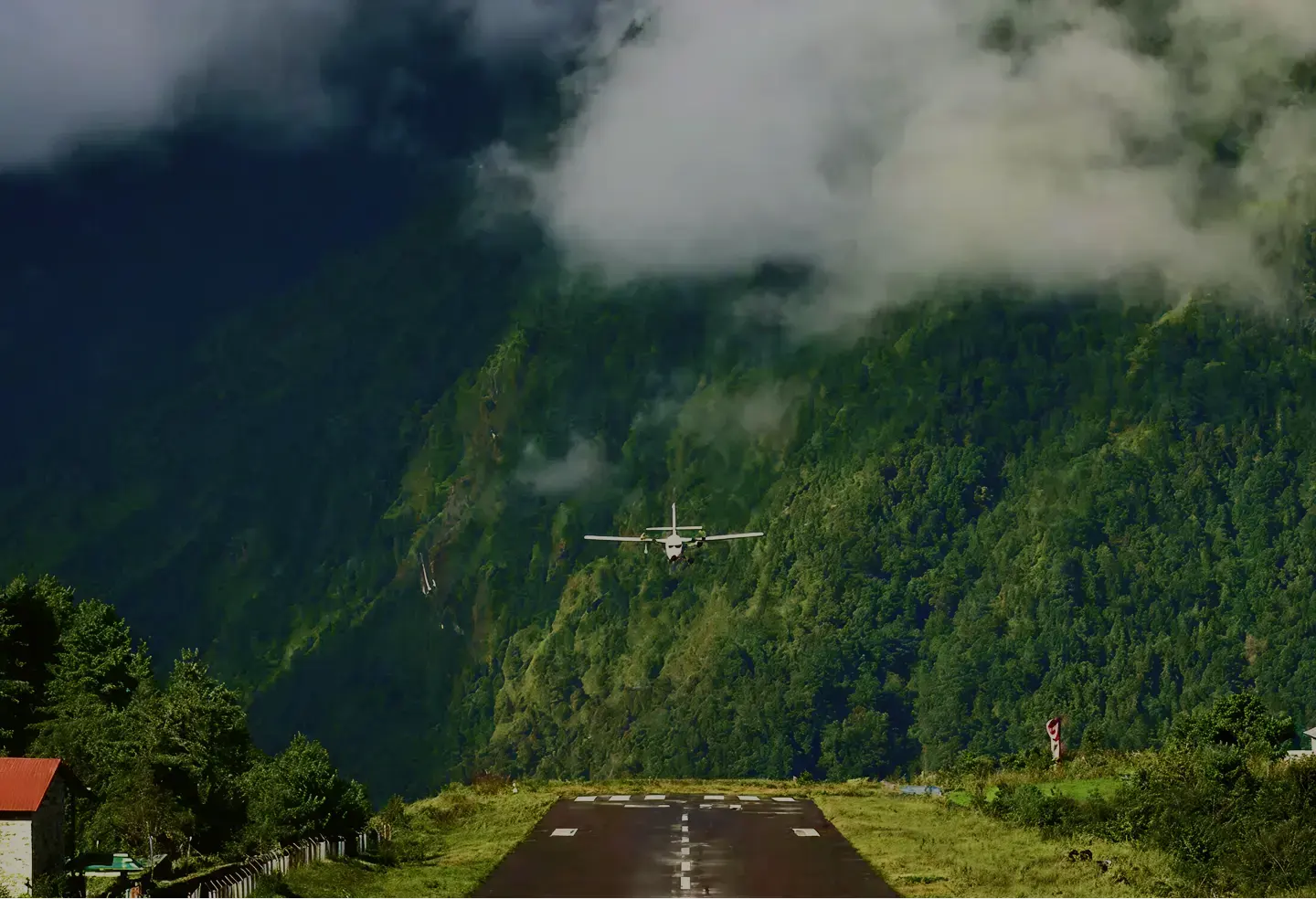
Nepal is a land of unparalleled beauty with stunning scenery of the Himalayas, ancient temples, traditional villages, green hills, and a variety of cultural experiences. The country of Nepal beckons the adventurous photographer and videographer through its majestic peaks of the Everest region, serene lakes of Pokhara and its beautiful landscapes of Mustang.
Drone photography, videography, and even drone filmmaking are thrilling activities for travelers, photographers, and content creators to do on these landscapes from the air. Aerial photographs offer a unique way to see the beauty of Nepal, from the mountains and valleys, the rivers and streams, the trekking routes, and the culture and heritage.
But there's more to becoming a drone pilot than just packing up your gear and heading to the airspace in Nepal.
In Nepal, there are regulations that are applicable to unmanned aerial vehicles (UAVs), or drones. The aim of these regulations is to ensure aviation safety, national security, safeguarding of cultural and natural heritage and respect for people's privacy.
As a foreign tourist in Nepal, professional photographer, filmmaker or a Nepali drone operator, it's crucial to know the rules and regulations before taking off.
If you are in any doubt about how to get a drone permit in Nepal, then this guide contains information on drone registration, documents needed for registration, responsible authorities, drone flight permissions, restrictions and important considerations before flying your drone in Nepal.
Is a Drone Permit Required in Nepal?
Yes, The Civil Aviation Authority of Nepal (CAAN) and the Ministry of Home Affairs (MoHA) are responsible for regulating drone operations in Nepal along with other relevant agencies.
Drone pilots need to know the difference between drone registration and drone permission to fly. Drone registration does not permit drone flights to be conducted in any part of Nepal.
Depending on the weight of the drone, flight location, purpose of flight and nature of the project, separate approvals may be necessary.
When flying in an open area, away from Kathmandu, there may be different requirements from that when flying in an airport, in a national park or around a protected cultural heritage site.
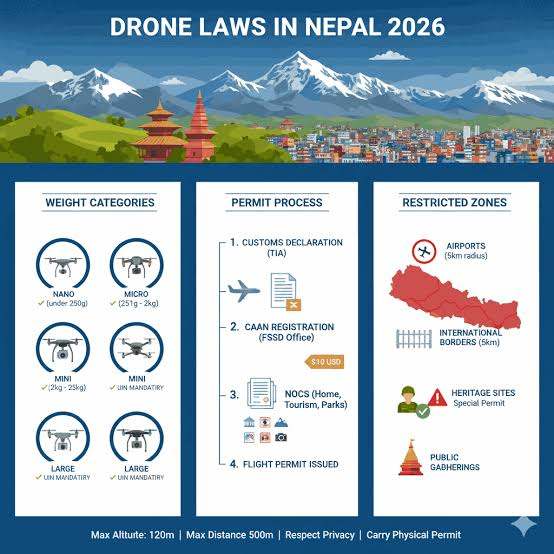
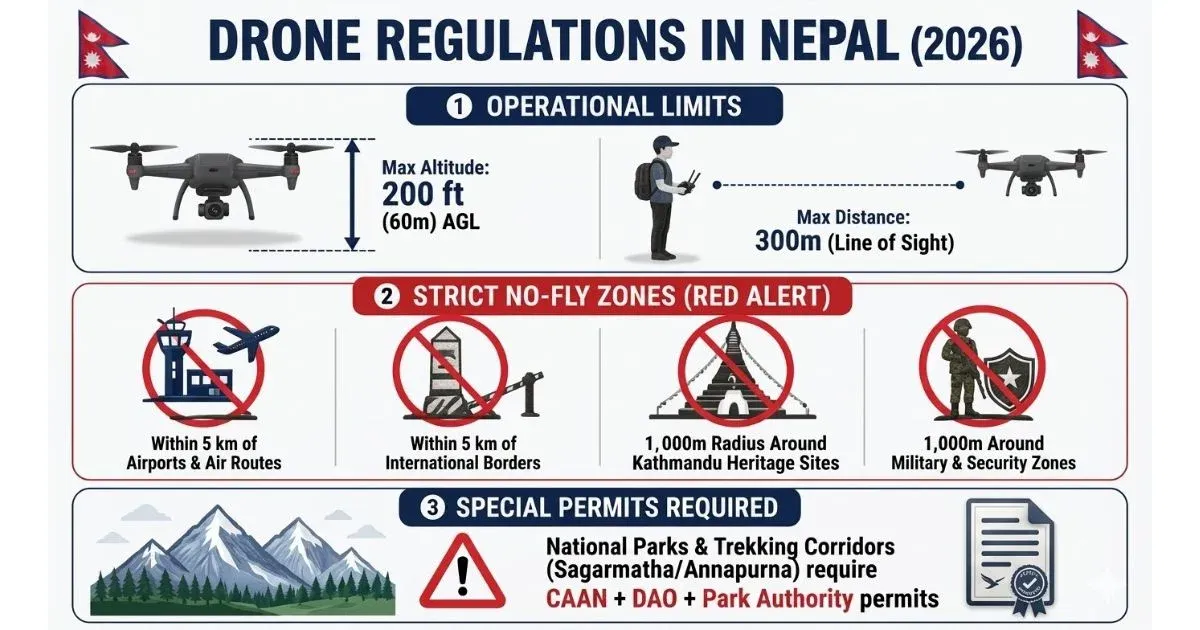
On 7th May 2026, the Civil Aviation Authority of Nepal (CAAN) issued another public notice regarding the operational restrictions: Maximum altitude above ground level (AGL) of 100 metres; Visual line-of-sight; Airport and sensitive area restrictions.
It is therefore essential to consult the most up-to-date regulations prior to a trip.
Which Authorities Issue Drone Permits in Nepal?
Several government authorities are involved in regulating drone operations in Nepal. Understanding their responsibilities can make the application process easier.
1. Civil Aviation Authority of Nepal (CAAN)
The Civil Aviation Authority of Nepal is the main regulatory authority in charge of aviation safety and drone registration.
Drone registration, assignment of a Unique Identification Number (UIN) and drone flight operation regulations are all conducted by CAAN in accordance with the aviation safety requirements.
It provides guidelines on its operation and requirements for approval prior to flying.
2. Ministry of Home Affairs (MoHA)
National security and public safety is the responsibility of the Ministry of Home Affairs.
Security clearance or permission from the Ministry of Home Affairs or the relevant District Administration Office may be necessary for the operation depending on the purpose and where it is to be carried out.
3. District Administration Office (DAO).
Local drone flight permissions are an important part of the District Administration Office.
The District Administration Office may process the flight permission for some operations with drones weighing less than 2 kg.
Applicants might be required to give information on the proposed flying area, purpose, time and equipment.
4. Department of National Parks and Wildlife Conservation (DNPWC)
Extra permission from the relevant conservation authority is required if you wish to fly a drone within a national park, conservation area or other protected area.
Operating a drone within the boundaries of Sagarmatha National Park, for instance, needs to be approved by the authorities (Department of National Parks and Wildlife Conservation and District Administration Office) and then by the park authority.
5. Other Concerned Authorities
Other approval may be required from:
The Ministry of Communication and Information Technology.
- Department of Tourism.
- Local government authorities.
- Security agencies.
- Heritage conservation authorities.
- Other responsible government ministries.
Not all drone operations need to be approved by all authorities. Requirements will vary according to type and location of proposed flight.
How to Obtain a Drone Permit in Nepal: Step-by-Step Process
Obtaining a drone permit in Nepal involves registration, document preparation, and approval from the concerned authorities.
Here is a general step-by-step process to help you understand how to apply.
Step 1: Register Your Drone with CAAN
First of all, you need to register your drone with the Civil Aviation Authority of Nepal.
Identification of equipment and owner is required with drone registration. Once registered, those eligible are assigned a Unique Identification Number (UIN).
Typically, it takes the following information to register a drone:
Manufacturer and model.
Drone serial number.
Manufacturing year.
Type and category of a drone.
Take-off weight.
Payload information.
Drone colour.
Personal/company information for the owner.
They will also require supporting documents including ID, drone specifications and proof of purchase or customs clearance.
Registration details and forms are available on the official CAAN website.
Step 2: Prepare the Required Documents
Once familiar with the requirements for registration, gather all the required documents.
Applications that are incomplete could result in a delay of approval. So it's better to prepare the documents beforehand to visit the concerned Government Office.
Typical documents that are needed are:
- Drone Application Form completed.
- A copy of citizenship certificate or a valid passport.
- Recent passport-sized photograph.
- Drone manufacturer's name and model.
- Drone Specifications Sheet/Drone User Manual.
- Photograph showing the drone and its serial number.
- Net price of the VAT bill, in Nepal.
- Imported - customs declaration or clearance documents.
- The intended use of the drone.
- Relevant commitment letter.
- Additional paperwork can include:
- Formal request letter.
- Plan of the proposed flight area.
- The coordinates of the operating area.
- Drone operation specifications.
A no-objection/recommendation letter from the relevant property owner/authority.
Security clearance or other necessary approvals.
The specifics of the checklist can vary from one operation to another and from one authority to another.
Step 3: Obtain Additional Clearance if Required
Once registered you may be required to receive further clearances prior to flight permission.
Some of the drone categories and operations are to be approved as per frequency need by the Ministry of Communication and Information Technology.
Always seek permission before flying a drone in a restricted area, protected region or security sensitive area.
This is especially crucial for professional photography, documentary production, research projects, commercial filming and tourism related aerial photography.
Step 4: Apply for Flight Permission
If you are now ready to apply for flight permission, please do so with the relevant body when you are ready with your registration and supporting documents.
If the drone is eligible (small drone), the District Administration Office may process the application.
In your application you should specify:
- Name of the drone operator.
- Objective of the flight.
- Model and weight of the drone.
- Proposed flight location.
- The date of the business and the period of operation.
- The height above sea level and range of flight.
- Contact information of the operator.
Certain district administration offices have forms and checklists of required documents readily available on their district websites.
For instance, the District Administration Office of Jajarkot has announced that they have a drone flight permission service for drones weighing less than 2kg, which requires an application, checklist, local level recommendation and purchase customs documents.
Always check with the DAO in charge of the area you want to fly in to verify the current procedure.
Step 5: Obtain Location-Specific Permission
Extra permissions could be required for your drone flight if it is in a national park, conservation area, heritage site or other sensitive area.
For example, in Sagarmatha National Park, there are multiple steps of permission that must be received before operating a drone.
The overall procedure is:
- Registration with CAAN.
- Approval from the Department of National Parks and Wildlife Conservation.
- Permission from the District Administration Office.
- Final permission from Sagarmatha National Park.
- There can be other protected areas that have their own processes.
- Don't expect a "general" drone registration certificate to function in each tourist area of Nepal.
Step 6: Receive Approval Before Flying
Once all the necessary applications have been reviewed and approved, you can proceed with your drone operation within the permitted conditions.
Keep copies of your registration certificate, flight permission, and other relevant approvals with you.
You must operate your drone according to the approved location, duration, altitude, and purpose.
Any change in the proposed flight plan may require further approval.
Documents Required for Drone Registration in Nepal
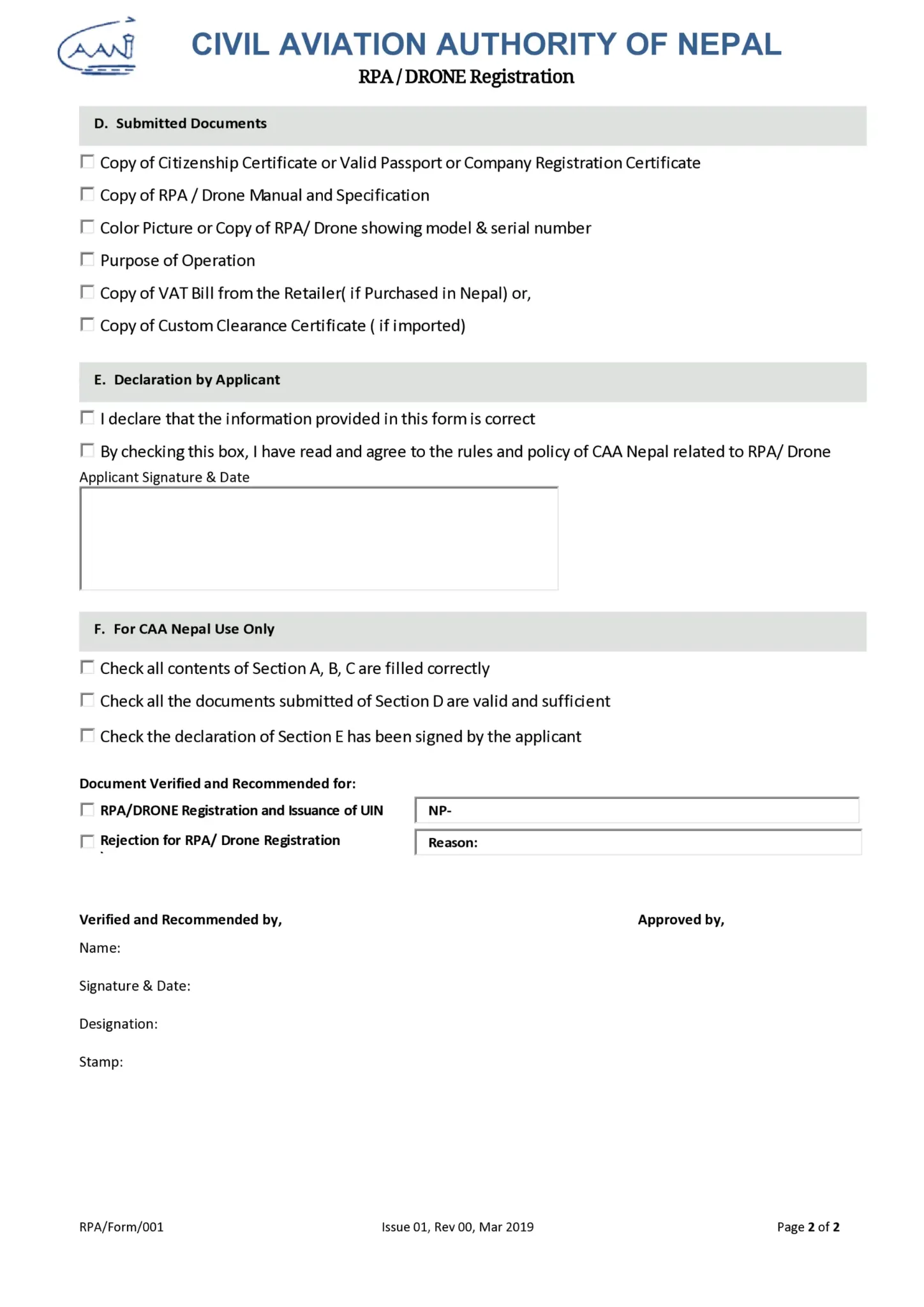
The following table provides an overview of the commonly required documents for drone registration.
| Documents | Purpose |
| Registration application form | Official drone registration |
| Citizenship or passport | Identification of the owner |
| Passport-sized photograph | Applicant identification |
| Drone specification sheet | Technical information |
| Drone photograph | Identification of model and serial number |
| VAT bill | Proof of purchase in Nepal |
| Customs clearance certificate | Proof of legal import |
| Purpose of operation | Explanation of intended use |
| Commitment letter | Agreement to follow regulations |
For flight permission, additional documents such as location maps, coordinates, request letters, and security clearances may be necessary.
Drone Permit Requirements for Foreign Tourists in Nepal
Every year, thousands of foreign tourists visit Nepal. Pilots are flying with their drones around the world to photograph their trekking, hiking, traveling to the mountains, and landscapes of the Himalayas.
Foreign visitors, however, are required to adhere to the same aviation and security codes of practice, and to register as a foreign national drone operator.
The Civil Aviation Authority of Nepal stated that foreign nationals planning to fly drones in Nepal need temporary drone registration from the Flight Safety Standards Department (FSSD) of the Nepal Civil Aviation Authority.
Applicants from abroad must come to the FSSD office and bring their drone for inspection as per current CAAN guidance.
Documents Required for Foreign Tourists
Foreign visitors should prepare the following documents:
- Valid passport.
- Valid Nepal entry visa.
- Signed letter of commitment.
- Details of the intended drone operation.
- Proposed flying locations.
- Duration of the operation.
- Additional supporting documents, if applicable.
The drone must also have valid CE marking indicating compliance with applicable safety, health, and environmental protection standards.
Foreign visitors should contact CAAN before travelling with their equipment to confirm the current registration procedure, inspection requirements, and applicable fees.
Where Can Foreign Tourists Apply?
Foreign applicants can contact:
Civil Aviation Authority of Nepal (CAAN)
Flight Safety Standards Department (FSSD)
Sinamangal Road, Kathmandu, Nepal
Email: [email protected]
Phone: +977-1-4111115 / +977-1-4111075 / +977-1-4111042
It is advisable to contact the department before visiting its office.
How Much Does a Drone Permit Cost in Nepal?
The cost of a drone permit in Nepal is determined based on the category of drone, the registering process and type of permission for the drone flight.
According to the information published on CAAN's website, registration for foreigners includes a registration fee of USD 50 + 13% VAT.
Other costs that can occur include:
- Flight permission applications.
- Frequency-related approvals.
- Specific insurance needs for specific categories of drones.
- Location-specific permissions.
- Other administrative requirements.
- The overall cost could thus vary between operations.
Always check with the relevant government department for the current applicable fees and payment procedures before you pay.
Drone Flying Rules and Regulations in Nepal
A drone registration certificate and permission to fly is just the first step. In addition to this, operators are expected to abide by the safety guidelines set by the authorities concerned.
Here are some restrictions to be aware of prior to flying.
1. Maximum Flying Altitude
As per CAAN's public notice dated 5th May 2026, drone flight is not allowed to be more than 100 metres above ground level unless otherwise authorized.
2. Keep Visual Line of Sight
Drone operators will always have to keep a visual line of sight with the drone.
Flying beyond the visual line of sight without explicit permission is not allowed.
3. Airport Restrictions
Prior approval is required for drone operations within 5 kilometres of airports and heliports.
But the drone pilot should not presume that a low altitude automatically makes airport operations legal.
Restricted and Prohibited Areas:
Drone operations are not allowed, or are limited, in certain locations.
These may include:
- Military installations.
- Police facilities.
- Government security locations.
- VIP areas.
- Sensitive infrastructure.
- Restricted airspace.
- Airport approach and departure areas.
Flying in these locations without specific authorization can result in legal consequences.
5. National Parks and Conservation Areas
Nepal has a number of national parks and conservation areas that safeguard vulnerable ecosystems, mountains, forests and rare wildlife.
Before any activities with drones start in these zones, you will need permission from the relevant authorities.
6. Night Flying Restrictions
Drone operations are not allowed at night unless there is specific authorization from CAAN.
7. Avoid Crowded Areas
Drones are not permitted to fly over public gatherings, events or over buildings and populated areas without permission.
It is the responsibility of the operator to take appropriate precautions to prevent accidents, injuries and property damage.
8. Respect People's Privacy
Drone operators need to respect the privacy of local communities, tourists and people.
Do not photograph people, private property or residential areas without consent.
Is it possible to take the drone with you on trek in Nepal?
Yes, you can shoot pictures with a drone during trekking in Nepal, but it will require approvals and the destination.
In Nepal, aerial photography offers the opportunity to capture the stunning beauty of the Himalayas, traditional villages, the rivers, glaciers, and mountain scenery.
But most of the popular trekking spots are within protected areas or restricted spots.
- Everest Region
The Everest region is one of the most popular trekking areas in Nepal. It is home to stunning landscapes of the Everest, Ama Dablam, Lhotse, Nuptse and other mountains in the Himalayas.
But the majority of the hiking trails are in Sagarmatha National Park.
All drone operators have to acquire the necessary authorisations from the appropriate authorities prior to flying within the park.
- Annapurna Region
The Annapurna region has various landscapes, such as: villages at the mountains, forests, glaciers and trekking trails at high altitudes.
Some of this area is included in the Annapurna Conservation Area.
Permission must be granted by the relevant authorities for a drone operation. Just signing up isn't enough.
- Langtang Region
The Langtang region is renowned for its scenic mountains, glaciers, forests and traditional Tamang settlements.
Considerable care must be taken when operating a drone in Langtang National Park, as this is a protected area and operators are required to have the relevant approval prior to flying a drone in Langtang.
- Mustang Region
The dramatic landscapes, ancient monasteries, traditional settlements and unique Himalayan culture of Mustang are its main points of interest.
Open landscapes might seem ideal for aerial photography, but operators need to account for flights and local security needs, as well as for conservation-related permissions.
Prior to embarking on a trek with a drone, find out the regulations that apply and get the necessary approvals for the route and location.
Can You Bring a Drone to Nepal?
Yes, drones are allowed in Nepal but it is not the same as importing and operating a drone.
Visitors on a drone from outside the country will need to fill in the relevant customs declaration and registration forms.
Foreigners are advised to verify customs procedure prior to their journey at Tribhuvan International Airport.
Drone flights are not regulated by law in Nepal, and there is no direct link between carrying a drone and operation.
Please be aware that it is advisable to contact CAAN before embarking on any journey, especially for professional filming, commercial photographs or longer flights with the drone.
What Happens If You Fly a Drone Without Permission in Nepal?
Flying a drone without the required registration or flight permission can create serious legal and security problems.
Authorities may take action depending on the nature of the violation and the applicable laws and regulations.
Possible consequences include:
- Restriction or termination of the drone operation.
- Confiscation of the equipment.
- Legal action under applicable aviation regulations.
- Financial penalties where provided by law.
- Additional investigation by security authorities.
Drone operators should never take unnecessary risks by flying without the required approvals.
Following the official procedure helps protect both the operator and the surrounding environment.
Important Tips Before Flying a Drone in Nepal
If you are planning to bring a drone to Nepal, a little preparation can save considerable time and inconvenience.
Here are some practical recommendations.
Register Early: Do not delay until the day of the flight to start the process of registering for the flight. Some of the permissions require more than one government office and may require more time.
Look up the location: Research whether your intended destination is in a national park, conservation area, airport restriction zone or security sensitive area.
Bring All Documents: Bring your drone registration certificate, flight approval, identification and customs documents.
Be aware of the weather: Nepal's mountains are unpredictable. Weather conditions like high winds, rain, snow, and low visibility can pose a risk to drone flights.
Respect Local Communities: Respect privacy and comfort of local residents. Do not trespass or film on private property or people without consent.
Follow Approved Flight Conditions: Do not exceed the authorized altitude, area or duration.
Check the Rules & Regulations: Drone rules and administrative procedures may be changed. Please check the most up-to-date requirements with CAAN and relevant local authorities.
Conclusion
Nepal has exceptional opportunities for aerial photography and videography. The country offers numerous opportunities to photograph some of the things that are truly memorable, from the majestic Himalayas, the beautiful trekking trails and ancient settlements to diverse landscapes.
But drone operation in Nepal is not without its planning and following government directives. Knowing how to register, getting paperwork ready, securing permissions for the location, and other aspects of aviation safety is crucial before hitting the skies.
As a foreign visitor, professional photographer, movie maker or hiker, complete the necessary legal requirements prior to flying.
Operating drones responsibly goes beyond avoiding legal troubles; it ensures the preservation of Nepal's natural environment, cultural heritage, and aviation safety.
Are you looking forward to travel to Nepal?
Nepal promises something extraordinary to every traveller from the breathtaking Everest region, the hidden valleys of Mustang and the picturesque walks of the Annapurna region.
Happy Mountain Nepal is committed to providing travellers with authentic experiences of the country, through memorable trekking experiences, cultural and heritage tours or tailor-made programmes.
Join us for the next adventure in the Himalayas and enjoy Nepal responsibly.
FAQs
- In Nepal, there is no restriction on flying drones without a permit.
Yes, The operators of the drone have to follow the registration and flight authorisation procedures of Nepal. The specific permissions will vary based on the type of drone, where it flies and for what reason.
- Can foreigners import drones to Nepal?
Yes, Foreigners are allowed to bring drones into Nepal with compliance of customs procedure and registration provision. Foreign nationals wishing to fly drones must have temporary registration through the Flight Safety Standards Department of CAAN.
- How to register my drone in Nepal?
The Civil Aviation Authority of Nepal (CACN) has established a Flight Safety Standards Department in Sinamangal, Kathmandu that is responsible for drone registration.
- What is the cost of drones registration in Nepal?
The CAAN requirements for foreign applicants are listed on their published registration requirements as USD 50 plus 13% VAT. Additional fees may apply based upon operation and permission required.
- What is the rule for flying a drone at Everest Base Camp?
Permission will be required from relevant authorities for drone flying in the Sagarmatha National Park. Registration and location specific permission must be completed prior to flight.