
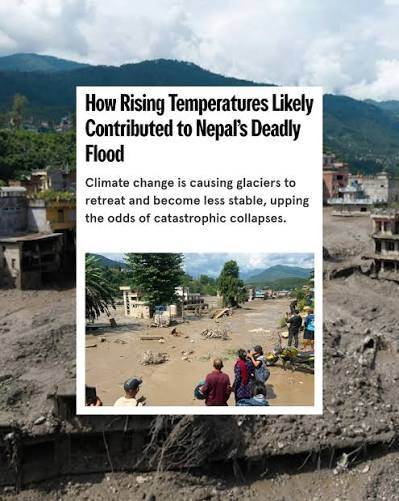
Climate Change & Global Warming: The Disaster for Nepal – Why?
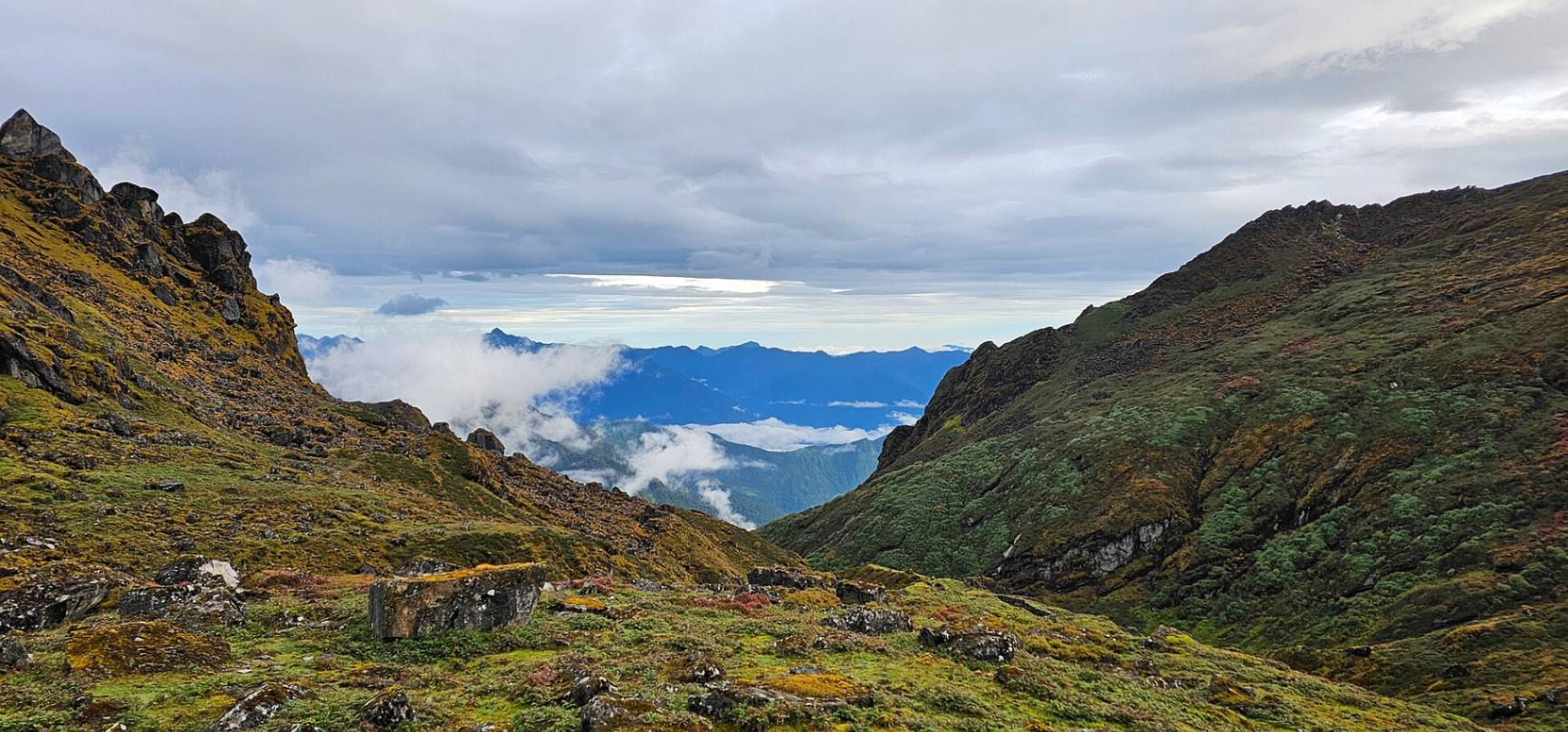
The Himalayas, snow-covered mountains, beautiful valleys, rivers, forests and rich biodiversity are the things Nepal is known for all over the world. Visitors from all over the world come to Mount Everest and the landscape of the Himalayas. But there's a real environmental danger behind this natural beauty.
Climate change and global warming are accelerating the change in Nepal, faster than many realize.
The impacts are noticed in the high Himalayas to the Terai plains. Glaciers are melting, precipitation is becoming more erratic, communities are at risk of flooding and landslides, and droughts and heat waves are becoming more worrying.
Climate change is not just an environmental concern in Nepal. It also poses a challenge to agriculture, tourism, water, energy, health, infrastructure, livelihoods and long-term development of the country.
Nepal has a very small share of greenhouse gas emissions, but is highly vulnerable to climate changes because of its geographical location and reliance on climate sensitive sectors. The World Bank has ranked the dangers of flooding, landslides, drought, heat stress to Nepal development.
Therefore, what are the impacts of climate change to Nepal?
What Is Climate Change and Global Warming?
It is very important to know the difference between global warming and climate change before comprehending the situation in Nepal.
Global warming is the gradual warming of the earth's average temperature, primarily attributed to the build-up of greenhouse gas (GHG) emissions like CO₂, methane and nitrous oxide in the atmosphere.
Climate change is a more general term. It covers changes in temperature, precipitation, snowfall, wind and extreme weather events over time, sea level rise and changes in the frequency and intensity of extreme weather events.
Human activities like burning fossil fuels, deforestation, industrial activities, transportation and unsustainable land use have led to an increase in the concentration of GHGs in the atmosphere.
This results in a warming climate. This warming combines with a very vulnerable geographical landscape in Nepal. The country is home to the lowest and the highest mountains on earth. The topography of Nepal is very much at risk to changes in humidity and temperature.
Why Is Nepal So Vulnerable to Climate Change?
The vulnerability in Nepal is a function of its geographic location, along with the climate-sensitive means of livelihood and its weak ability to respond to disasters.
The country is divided into three major geographical areas that are the Terai, Hills and the Himalayas. Climate change is felt differently in each region.
There are rapid changes in snow cover and glaciers in the Himalayas. The hills are at risk of landslides, flooding and variations in rainfall. In the meantime, the risk of flooding, heat and drought is rising in the Terai region.
Agriculture, hydropower, tourism, forests and natural resources also play a critical role in the economy in Nepal. These sectors are very climate and weather related.
The World Bank has cited that the country's economy is already being impacted by climate change and the threat of future floods, heat stress and agricultural and livestock losses will limit economic development.
This implies climate change can impact Nepal not in one disaster but a variety of interconnected problems.
1. Melting Glaciers: A Major Warning for Nepal
Perhaps the most visible impact of climate change in Nepal is the changing Himalayan landscape.
In Nepal there are many glaciers which provide the storage of freshwater in the form of snow and ice. These glaciers are vital for river and ecosystems water supply.
But the speed of ice melt in the Himalayas is increasing.
ICIMOD's 2026 assessment says that the rate of glacier melt in the Hindu Kush Himalaya is almost twice as fast as it was at the start of this century. The evaluation showed ice thickness losses of up to 27 metres since 1975, in the region. (ICIMOD)
This is especially alarming in Nepal as the Himalayas are not just mountains. They play a significant role in the water system in the region.
Climate change can initially lead to an increase in melt water due to the glaciers melting faster. However, as glaciers evolve and melt, water resources are reduced over time.
This raises an important question:
What would happen if the Himalayas' natural water storage facility gets smaller and more unreliable?
The answer is going to impact drinking water, agriculture, hydropower, ecosystems and millions of people downstream.
2. The Risk of Glacial Lake Outburst Floods
There is another threat related to glacial melting: Glacial Lake Outburst Floods or GLOFs.
When glaciers recede and melt water can build up in lakes in front of or near glaciers. These lakes are enclosed by precarious natural dams such as ice, rocks and sediments.
When such a dam breaks, there can be a tremendous surge of water flowing through it.
This can result in the destruction of bridges, roads, settlements, hydropower infrastructure and agricultural land.
The changing cryosphere in the Hindu Kush Himalayas is posing new threats such as floods, landslides and glacial lake outburst floods, warns ICIMOD.
In the case of mountain valley communities, these events can be highly hazardous since there may be limited time to react.
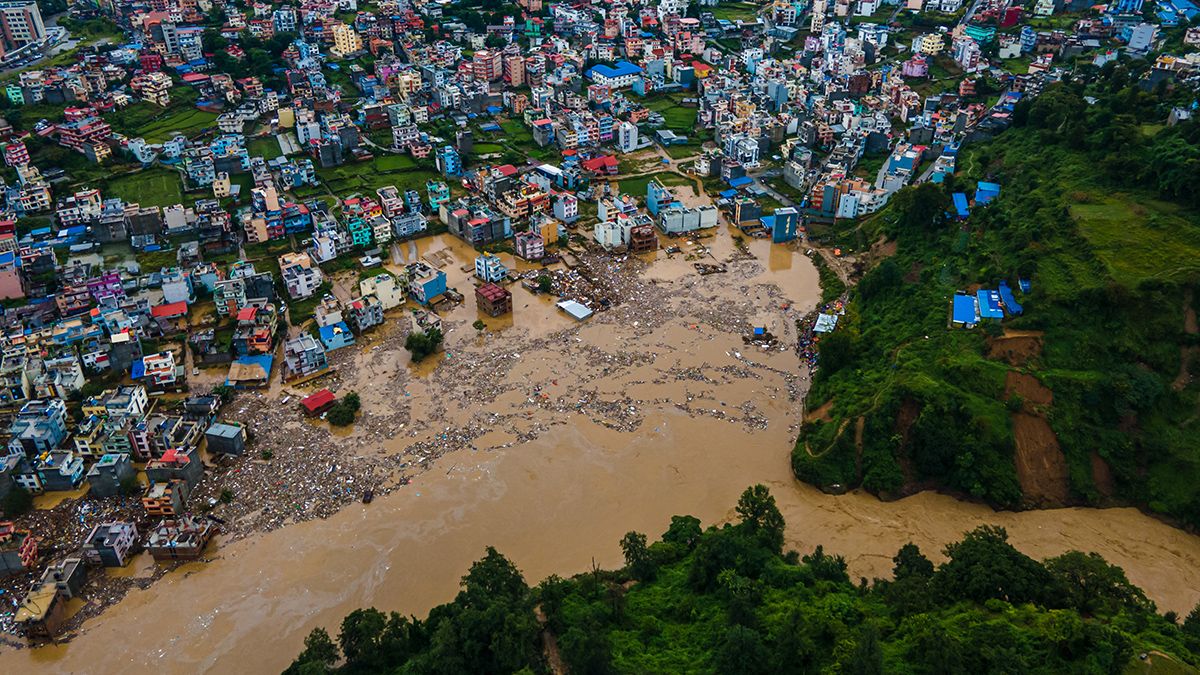
3. Increasing Flood Risk
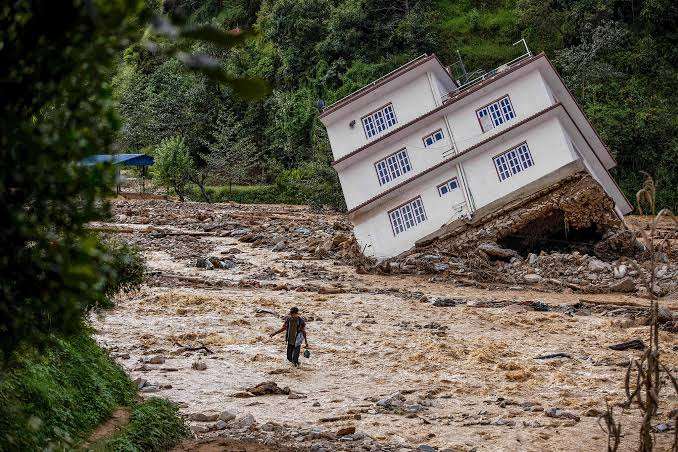
Nepal is not an unfamiliar country to flooding. Numerous areas of the country flood during every monsoon.
But climate change may introduce increased variability and intensification of rainfall.
The monsoon in Nepal is a critical factor for agriculture and water resources. However, if rain comes in torrents over a short period of time, rivers can swell quickly and flood the land.
Terai is more vulnerable due to its fairly flat topography and abundant river system.
Floods can damage:
- Homes and settlements
- Roads and bridges
- Agricultural fields
- Schools & Health facilities
- Electricity infrastructure
- Irrigation systems
- Businesses and local markets
Flooding can also pollute drinking water and cause the spread of water-borne diseases.
The World Bank identifies flooding as one of the key development threats due to climate change in Nepal.
4. Landslides and Unstable Mountain Slopes
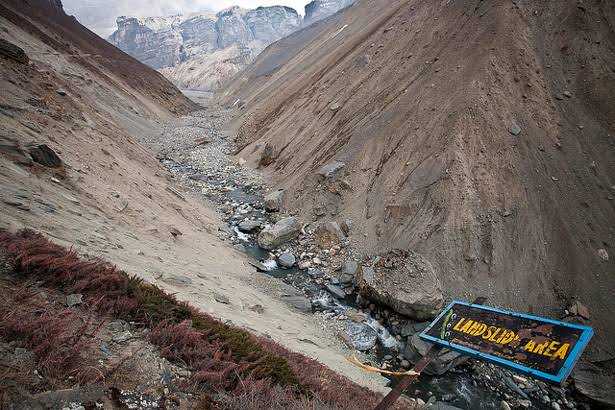
The steep topography, geological conditions and monsoon rains make landslides a common occurrence in the hills and mountains of Nepal.
Climate change can make this situation more complicated.
Heavy rain may cause erosion and saturation of the soil. Warming may also impact snow and ice conditions, as well as permafrost conditions, at higher elevations.
Permafrost changes, snowfall and precipitation changes in the Hindu Kush Himalayan region, landslide risks will be higher in many places.
Remote communities can be isolated for days and weeks during a landslide.
They can also severely damage trekking trails, highways as well as rural roads.
This poses a significant problem in Nepal being a mountain nation with regard to transportation and development.
5. Climate Change Is Threatening Nepal's Agriculture
Agriculture continues to be one of the significant aspects of life & livelihoods in Nepal.
Precise and regular rainfall patterns are a critical need for farmers and optimal temperature and water availability are also essential.
All three can be impacted by climate change.
The fluctuation in rainfall can give rise to contrary problems:
- Excessive water may cause flooding and water-logging, resulting in crop damage.
- Lack of water at the wrong time can lead to drought and the failure of crops.
- Higher temperatures may also impact farm and animal production.
Climate effects along with the impacts of flooding and heat stress on crops and livestock are among the ongoing challenges for Nepal's economic development identified by the World Bank.
Seasonal farming is vital for small farmers, and for them, a crop failure can mean significant food insecurity and income loss.
6. Water Security Could Become a Major Concern
Nepal is a water rich country as it has a lot of rivers, lakes, glaciers and springs.
Not all water resources translate to reliable access to water.
Climate change can change when, where and how much water is available.
Monsoon heavy rainfall and flooding can occur in some communities and water scarcity during dry seasons.
Some changes in springs and water availability are already occurring in many mountain communities. Meanwhile, fast glacier retreat raises questions about how water will flow in the future.
7. Extreme Heat in the Terai
Many people associate melting snow and cold mountains of the Himalayas with the idea of climate change in Nepal.
However, climate change is also posing significant threats in the Terai.
Areas in the southern plains are capable of very high temperatures at times, especially before and during the monsoon.
Excess heat has a negative impact on human health and productivity.
Labourers, such as those working outdoors, farmers, construction workers and transport workers are at risk for severe heat stress.
There can also be effects from high temperatures on livestock and crops.
Thus, the linkage between the mountains and plains of Nepal in relation to climate change is not the same in all aspects. The mountains are vulnerable to glacier and landslide hazards and the Terai is vulnerable to rising heat, flood, water related issues.
8. Nepal's Forests and Biodiversity Are at Risk
Nepal is a country with a high biodiversity. The country also has a remarkable diversity of habitats ranging from the tropical forest of the Terai to the alpine areas of the Himalayas.
These ecosystems can shift in light of a changing climate.
With the rise of temperature, plants and animals may require to migrate to a higher elevation or a new habitat.
The non-adaptable or non-migratory species are likely to become more vulnerable due to slowly.
Variations in precipitation, drought, fire, and invasive species and habitat destruction may add further challenges to biodiversity.
The cryosphere and ecosystem of the Hindu Kush Himalaya have undergone major changes and are likely to continue to change with an acceleration of impacts and biodiversity loss being projected in the region.
The first and foremost concern of forest protection is not only to protect wildlife in Nepal. In addition to the aforementioned benefits, forests offer local livelihood and tourism, watershed, and soil stability.
9. Climate Change Is a Threat to Nepal's Tourism Industry
Tourism in Nepal is one of the key industries in the country's foreign sector.
Trekking, mountaineering, wildlife, culture, heritage and adventure are reasons for visiting Nepal.
There are many ways in which climate change can impact tourism.
The shift in precipitation may affect the mountain scenery and other hiking conditions. As glaciers melt, routes and environments for trekking and climbing can be altered. Trails, roads and bridges may be damaged by landslides and flooding.
Extreme weather also can make travel more erratic.
The Himalayas are turning into a big icon of the climate crisis.
ICIMOD has recorded some of the massive changes that have taken place around Mount Everest such as accelerating glacier thinning in the Everest region.
The protection of mountain environments is equally significant for the protection of the tourism industry, especially in a country where tourism is closely associated with the Himalayas.Protection of mountain environments is also crucial for the protection of the tourism industry, particularly in a country where tourism is closely linked to the Himalayas.
10. Hydropower Is Both an Opportunity and a Climate Risk
Nepal has huge hydropower potential as it has steep topography and rivers.
Hydro power can also be a means for Nepal to move towards cleaner energy.
But climate change poses threats to hydropower facilities.
Dams, tunnels, roads and transmission can be affected by floods, landslides, changes to river flows and glacial lake outburst floods.
This implies that future hydropower projects should take into account the conditions of the river now as well as future climate conditions.
There will be a greater need for climate-resilient infrastructure.
11. Climate Change Can Increase Poverty and Inequality
Climates change unequally for different people.
Those who do not have a lot of money may not have as many choices during an emergency.
A prosperous family might be able to put up again a broken home and/or move temporarily or find an alternative means to income.
If a farming household is in bad shape, it can have none of these things.
Women, children, older adults, and people with disabilities and indigenous communities may experience extra challenges in the event of a climate disaster.
The World Bank has pointed to the disproportionate, and cumulative, effects of climate change on women, Indigenous people, and other marginalised groups in Nepal.
Climate change is therefore a social justice and development challenge as well.
12. Climate Change Can Increase Migration
When agriculture is no longer a reliable source of income, water is less available or when disasters frequently hit homes and infrastructure, people can leave their communities.
This can lead to higher in-migration from rural and mountain areas towards cities and towns.
Migration in itself is not bad. The pressure on urban housing, employment, transport, water supply and public services is however further aggravated by sudden or forced migration.
Climate change may thus be linked to broader social and economic shifts that are not necessarily related to the disaster itself.
13. Nepal's Climate Problem Is Connected to the Rest of the World
It is vital to realize that the global climate crisis is not something that Nepal is solely responsible for. Nepal's GHGs contribution is minimal when compared with the major GHG emitters. The World Bank considers Nepal as a minor emitter of greenhouse gas and a significant climate change adapter.
This raises a critical climate justice issue.
Global warming effects can be devastating for countries that are only a minor contributor to global emissions. International climate finance, technology transfer, scientific cooperation and regional cooperation is thus part of Nepal's climate action.
Climate Change in Nepal Is Not Just a Future Problem
Climate change can easily be perceived as a phenomenon that will occur in decades.
However, climate changes are already occurring in Nepal.
Glaciers are melting at a faster rate. Climate change is occurring in mountainous environments. Communities and infrastructure are vulnerable to floods and landslides. Farmers are facing up to the shift in climate. Heat is becoming an increasing concern in the southern plains.
Scientific information from the Hindu Kush Himalaya indicates that snow, ice and permafrost changes are already occurring and will continue to happen.
It is not, therefore, a question of whether or not Nepal will experience climate change, but rather how.The real question is, therefore, how will Nepal experience climate change?
The question is how ready Nepal will be for what is to come.
What Can Nepal Do About Climate Change?
Global warming cannot be prevented by individual action of Nepal.
Nepal, however, can do much to lessen its vulnerability, as well as take part in global climate action.
Support CREE
Nepal has significant hydropower potential and opportunities for solar and other renewable energy.
The growth of clean energy and better energy use efficiency can help to decrease fossil fuel consumption and help to achieve a lower carbon economy.
Conserve Forests and Watersheds
Forests play a significant role in sequestration of carbon and are a source of protection for soil, water and biodiversity.
Engaging in community-based forest management, rehabilitating degraded lands and watersheds for conservation can bolster climate resilience.
Build Climate-Resilient Infrastructure
The infrastructure should be adapted for future climate risk (roads, bridges, hydropower plants, settlements and schools).
Floods, landslides, extreme rainfall and water availability fluctuations should be taken into account for infrastructure planning.
Improve EWS
Early warning systems can save lives.
Rivers, glaciers and unstable slopes are close to communities and they require information in timely manner with regards to floods, landslides and glacial lake outburst floods.
Technologies should be used alongside with local knowledge and community readiness.
Support Climate-Resilient Agriculture
The farmers require access to drought-resistant and climate-suitable crops, as well as better irrigation technology and weather forecasting, crop diversification, and agricultural technology.
Climate smart farming can contribute to mitigating the vulnerability of rural communities.
Strengthen Disaster Preparedness
Good disaster preparedness is needed at District/Provincial and Federal level in Nepal.
The importance of local governments is particularly emphasized as they are the ones located in closer proximity to communities and will be implementing a number of resilience measures.
World Bank's climate and development activities for Nepal have focused on building resilience and mainstreaming climate into development planning. (World Bank)
Ensure more sustainable tourism.
Nepal's tourism industry needs to ride the wave of the changing mountain conditions.
Preserving the interests of visitors and local communities can be achieved through sustainable trekking, responsible waste management, safer trails, climate-resilient tourism infrastructure and better disaster preparedness.
Increase Climate Awareness
Governments are not the only ones who are responsible for acting on climate change.
There is a role for every element in the school, university, business, tourism, farming, and local community sectors and for individuals.
Understanding climate change is the first step towards responding to it.
What Can Individuals Do?
No single action can overcome government policy or international climate action, but it does count.
People in Nepal can contribute by:
- This can be achieved by minimising unnecessary consumption of energy.
- If it is possible using public transport.
- Walking or cycling for short distances
- Reducing unnecessary waste
- Avoiding single-use plastics
- Plants and trees are planted and protected.Planting and protection of trees.
- Conserving water
- Promoting local and sustainable products
- Reducing waste for unnecessary burning;
- Practising responsible tourism
- Knowing the risk of climate change to their communities
- Participating in local environmental programmes
While the small actions matter, they are more significant if they are aligned with institutional and policy level changes.
Nepal's Himalayas Need Global Action
The Himalayas are not only the treasure of the country Nepal.
The Hindu Kush Himalaya is a significant source of freshwater to the vast population of Asia. According to ICIMOD estimates, the snow and ice in the region serve the freshwater needs of almost 2 billion people.
Thus, it is not only the responsibility of Nepal to protect the Himalayas.
It demands cooperation between the Himalayan countries and the downstream countries, and the international community.
Emissions of greenhouse gases in the rest of the world must be further reduced. Countries such as Nepal, however, must be helped to prepare for climate impacts that are already happening.
Climate Change and the Future of Nepal
If Nepal is to realize the potential of its future, it will depend largely on how it uses its natural resources.
There are mountains, rivers, forests, fertile plain in the country and extraordinary biodiversity. These natural resources sustain millions of lives, and are the bedrock of key industries like agriculture, tourism and hydropower.
However, these resources are not inexhaustible.
The impacts of glacier melt will extend beyond the environment if they continue to recede and become more unpredictable, extreme events will grow in intensity and ecosystems will become more fragile.
They will impact the human population, livelihood, food, water, infrastructure, tourism and the economy.
That is the reason why climate change should not be an environmental issue far removed from our everyday lives.
It's a developmental problem.
It's an economic problem.
It's a "disaster risk" problem.
And for Nepal, it is also a question of protecting the country's natural and cultural heritage for future generations.
Final Thoughts: Why Is Climate Change a Disaster for Nepal?
Nepal is one of the countries that has contributed relatively little to global greenhouse gas emissions but faces significant exposure to climate risks.
Its geography makes the country particularly sensitive.
The Himalayas are warming and losing ice. Rivers face changing flows. Glacial lakes can create new hazards. Monsoon rainfall can become more unpredictable. Floods and landslides threaten communities. The Terai faces increasing heat and flood risks. Agriculture and tourism face uncertainty. Biodiversity and ecosystems are under pressure.
The situation is serious, but it is not hopeless.
Nepal has opportunities to build a greener and more resilient future through renewable energy, forest conservation, climate-smart agriculture, sustainable tourism, stronger infrastructure, early warning systems and effective disaster preparedness.
At the same time, global action is essential because climate change does not stop at national borders.
Nepal's mountains are sending a message to the world: the climate crisis is not a problem of tomorrow. It is already changing the landscapes, communities and livelihoods of today.
Protecting Nepal from climate change means protecting its people, rivers, forests, mountains, wildlife, culture and future.