
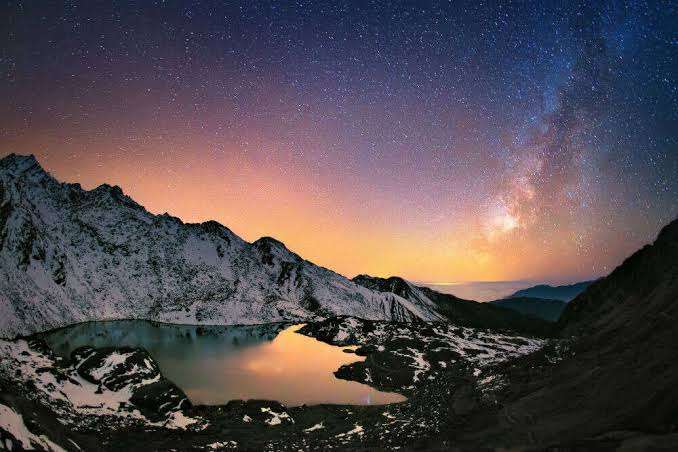
Trekking to Kajin Sara Lake
Kajin Sara Lake is a high-altitude trek; however, it is much more than that. It is a trek to one of the least-travelled regions in the entire Nepalese Himalayas. The trekking routes leading to Kajin Sara Lake differ from the other popular trekking routes (Everest Base Camp and Annapurna Base Camp treks) mainly due to their remote and rugged trail systems and limited commercial activity in the region. Trekkers will traverse through lush forests, traditional Himalayan settlements, alpine meadows, glacial valleys, and the rugged mountaintops of the Himalayas before reaching the pristine Lake Kajin Sara.
The trek begins in the Manang District administrative centre in Chame, located at the junction of the well-known Annapurna Circuit trail and the northern edge of the Manang Valley, and is approximately at an altitude of 3,200 metres (10,000 feet). It is a requirement for a person wishing to undertake this trek to have had either previous trekking experience or to be in excellent physical condition. The trek will consist of both ascents and descents, and depending on your pace, you can be walking long distances over several days at a time, with most days being longer than 10 hours. To be successful at reaching elevations above 5,000 metres (16,400 feet), trekkers will need to have a very high level of fitness and/or to be walking with a local guide or have received some form of formal instruction.
Day 1: Drive to Chame and Trek to Lamjung Himal Base Camp
The expedition will be an enjoyable experience from the city of Kathmandu or Besisahar to the town of Chame along the route that runs beside the beautiful and magnificent Marsyangdi River, passing through small villages, terraced farming, cascading waterfalls, and stunning mountains (Annapurna range). As the vehicle rises into the Annapurna range, the transition of the natural environment will have a better impact on the experience.
The final preparations for the trek to Lamjung Himal Base Camp will be made after arriving at Chame. The trek will venture away from a busy community into quiet wooded areas dominated by tall pine trees and rhododendron trees. If your trek occurs in spring, you will have the opportunity to see thousands of blooming rhododendrons on the hills, which is the national flower of Nepal.
As the muscle climbs to altitude, the dense forest will diminish, giving way to open grassland which provides summer habitat for yaks and sheep. The entire length of the trek will afford terrific views of Lamjung Himal, Annapurna II, Annapurna IV, and many other snow-covered peaks.
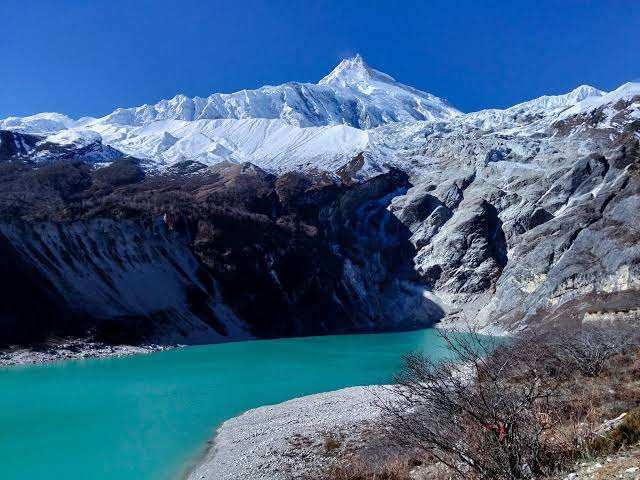
The first overnight stop along this route is at Lamjung Himal Base Camp, which has breathtaking views of many peaks surrounding you. This is also a great spot to acclimatise to the elevation as there will not be too much air pressure on you while you sleep. The extra night here will allow your body to become accustomed to the lower oxygen levels gradually thereby decreasing your chance of experiencing altitude sickness later during your trek.
Highlights:
- Scenic drive to Chame through the Himalayas
- Day-hike on the trails through lush pine and rhododendron forests
- Several beautiful waterfalls and streams
- A close-up first view of Lamjung Himal
- Overnight stay at Lamjung Himal Base Camp
Day 2: Trek from Base Camp to High Camp
This second day will require you to push yourself again with the trail climbing steadily upwards towards High Camp. As you progress along the trail, the surrounding environment will be less forested and more ruggedly rocky and increasingly rugged. You will cross alpine meadows, glacial moraines and steep mountain slopes, allowing you to see every single peak in the Himalayas around you without obstructions.
As you ascend into higher altitudes, past 4500 meters, the humidity decreases significantly, resulting in thinner air. Because of this, it is necessary to take your time to make sure to go up slowly and to hydrate frequently and rest during the course of your trekking day.
The wilderness that is found in this area is another aspect of the trek that will stay with you. When compared to popular trekking routes in Nepal, you will often go for hours without seeing another trekker. The only sounds are the wind blowing through the mountains, far-off waterfall sights and sounds, and occasional wildlife.
If the weather permits, you may see Himalayan blue sheep grazing high on steep rock faces, soaring eagles, Himalayan griffon vultures, and (if you are lucky) a Himalayan marmot.
High Camp, located on a relatively level alpine plateau, has some of the most breathtaking views anywhere in the world of glaciers and many of the tallest peaks of the Himalaya Mountains. At night you will see more stars than you could possibly imagine.
Because on the following day you'll be climbing to over 5000 meters, you'll need to eat well, stay hydrated, and get enough sleep.
Highlights:
- Gradual ascent through an alpine environment
- Views of the Himalayan Mountains from many different locations
- Views of glacial valleys and ridges of mountains
- Opportunities for interesting and varied wildlife
- Overnight stay at High Camp, at an elevation of more than 5000 meters
Day 3: Hike to Kajin Sara Lake and Return to High Camp or Base Camp
This is likely to be one of the most exciting and rewarding days of your entire trek! You will need to get an early start (before sunrise) to benefit from the good light conditions (maximum daylight) and reasonable weather in the morning.
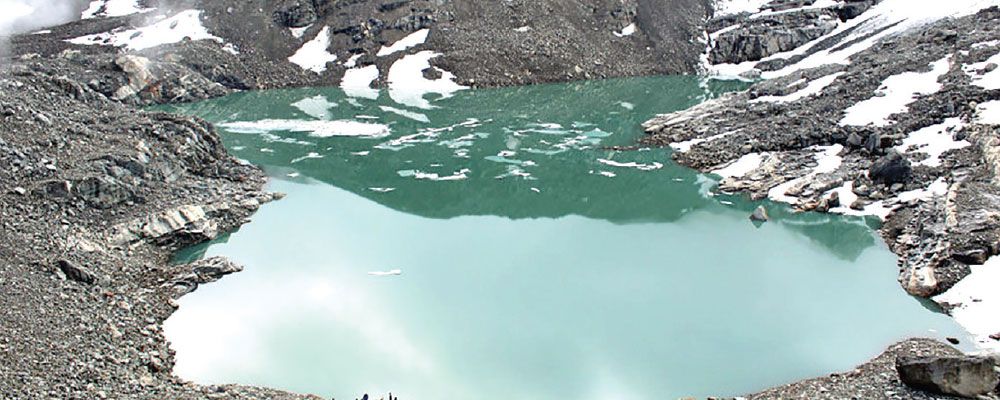
Once you have climbed up the rocky slopes and crossed a small glacier, you will arrive at the stunning blue-green Kajin Sara Lake. As the sun rises and begins to illuminate the surrounding snow-capped mountains, the lake becomes a canvas of various shades of blue and green, two colors that contrast beautifully with one another and one of the most picturesque alpine settings in all of Nepal.
Kajin Sara Lake is located in a remote, pristine wilderness area, surrounded by the high peaks of the Himalayan mountains. It is an incredibly peaceful area with no hotels, shops or other types of permanent habitation just pure nature.
After arriving at the lake, most trekkers will spend some time (often several hours) at or near the shore of the lake taking photographs and enjoying the scenery, eating their packed lunches, and resting before beginning their descent back down the trail.
The weather at this altitude can rapidly change, and by the afternoon there are usually strong winds, snow showers, or low clouds that suddenly appear. Therefore, almost all trekking groups will leave the lake before noon.
Depending on the planned route and how bad the weather is, trekkers will either go back to High Camp for one more night or go lower down the mountain to Lamjung Himal Base Camp.
Highlights:
- Sunrise hike through high-alpine areas
- Arrive at Kajin Sara lake
- Beautiful turquoise glacial lake
- Great views of all Annapurna and Lamjung Himal ranges
- Take pictures and explore one of Nepal's very remote lakes.
Day 4: Descend to Chame
As trekkers descend from the last day of their trek on Nepal's newest and highest alpine lake, they are able to experience the same scenic view that they had seen while trekking up to Chame, on their way back to Chame.
Because they are now at a lower altitude than where they were trekking up to and have more opportunity to breathe, with any difficulties they had in breathing at higher elevations, returning through civilization from the end of day four will be a good time for trekkers to reflect on their incredible once-in-a-lifetime trip to one of Nepal's newest and highest known alpine lakes.
Trekkers will celebrate their last day by completing their journey into Chame. Many trekkers will continue on in the Annapurna region after finishing their journey back to Chame, while others will return to Kathmandu for their next adventure.
Highlights
- Scenic descent through forests and valleys
- Final views of the Himalayas
- Return to Chame
- Completion of an unforgettable experience in the Himalayas
Trek Difficulty
Due to its high elevation, location in the backcountry, and the absence of established trekking facilities, Kajin Sara Lake Trek has been described as moderately difficult. While technical climbing skills are not generally required under normal circumstances, trekkers do need a high level of physical fitness, have prior experience in trekking, as well as having adequately acclimatized to the elevation (and/or surroundings).
For this reason, hiring an experienced local guide is highly advisable since conditions on trails, weather, and trail markings may all differ substantially. In addition to employing a local guide, trekkers should also pack tenting equipment, warm clothing, food, and other necessary supplies because there are very limited available accommodations along the route to Kajin Sara Lake.
Conclusion
Kajin Sara Lake is one of Nepal’s most interesting and beautiful high-altitude trekking destinations because not only is it extremely high but also very remote (and has a 'sense of discovery'). It is located amongst the breathtaking alpine scenery of the Manang Valley in Nepal, and represents some of the original nature untouched by humankind in the Himalayas (where only the sound of the wind blowing over the mountains, the sound of ice falling from the mountains (aka avalanches), and the footsteps of other determined trekkers can be heard).